

15 Literary Character Types Every Reader Should Know


You know how sometimes you can be in the middle of a conversation with another reader, gushing about your latest favorite book and then they say a word you’ve never heard before. Byronic hero? What is that? If that’s been you, then this post is for you.
This is part of our Genre 101 series, where we break down the building blocks of books from a reader’s perspective. Today we are here to give you the basics to understand the most common literary character types especially as they are found in romance. These are the general categories, not the specific archetypes like the gruff cowboy or the brooding billionaire.
They are another layer of a story that can help you understand the structure of a book better. And next time, you’ll be the one pointing out hey this is an unreliable narrator!
If you’ve already explored the difference between genre, subgenre and trope, literary character types are the next layer down on the book structure. The building blocks, if you will, of the actual story. This is how authors shape the people we fall for, we fear and we can’t stop thinking about.
This post contains affiliate links. That means we receive a small commission at no cost to you from any purchases you make through these links.
The Main Players
Every story has a center of gravity and these are the characters who create it. In a romance, we are usually referring to the protagonist, the love interest and the antagonist or villain, if there is one.
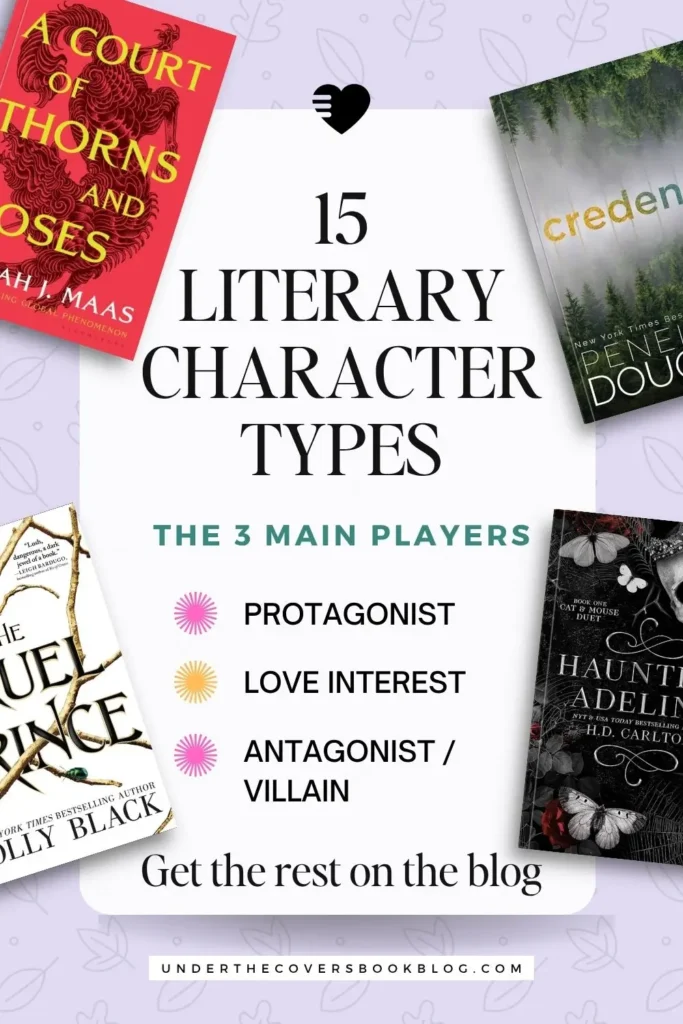
Protagonist
You know that character that everything seems to revolve around? That’s the protagonist. We may think in romance that is harder to spot because sometimes the two main characters feel they have the same weight. And at times that may be true. But we have to look at who gets more page time, has the biggest emotional arc, even the clearest goal for their growth within the story. All of that will help us find our protagonist.
But protagonist doesn’t mean they are a hero (or good guy). There are protagonists that stay with you and connect, but they are often flawed and/or morally complicated. Let’s look at Feyre from ACOTAR for example. She starts out as a girl trying to survive and ends up bending the world around her. Or Regan from Credence by Penelope Douglas, who makes choices that will disturb you. Both are protagonists but they don’t fit a simple hero mold.
The useful distinction is that a protagonist means main character, not good person. Keeping those two ideas separate opens up a lot of more interesting reading. I personally love an unlikeable main character in some ways.
Antagonist and Villain
Ah this is a point I often see some confusion. See, every villain in a story is an antagonist, but not every antagonist is a villain. This is the important distinction to remember.
The villain is the bad guy and the antagonist is just in the way. An obstacle, if you will.
The antagonist doesn’t always have to be a person, but they are the source of conflict for the book. For example, a well meaning parent blocking a protagonist’s choices is an antagonist. So is a rival or a deadline. However, the villain harms deliberately with cruelty and malice.
In romance especially, the most interesting tension usually comes from antagonists who are not villains at all. And the moment you start to see things from their POV or logic, sometimes they even make sense. Which makes things even more complicated.
Love Interest
The love interest is the character the protagonist is drawn to romantically. In romance, this is often a co-lead with as much page time as the protagonist. In fantasy or thrillers, they may have less page time but carry a lot of emotional weight.
It’s important to note that the traditional shorthand for love interests has defaulted to hero and heroine or MMC and FMC, which assumes a gender binary that does not include all romance. I recently saw more conversation about this online and I think it’s a topic worth exploring and paying attention to more. But for purposes of our definition here, the love interest is the one that has our protagonist’s heart, regardless of gender.
What makes a love interest work is not perfection. It’s the sense that this particular person is the only one who could create this particular tension with the protagonist. When that chemistry is missing, no amount of attractive description fixes it.
The Supporting Cast
If the story is worth its weight, the supporting characters are not decoration. The best ones can make the whole story!
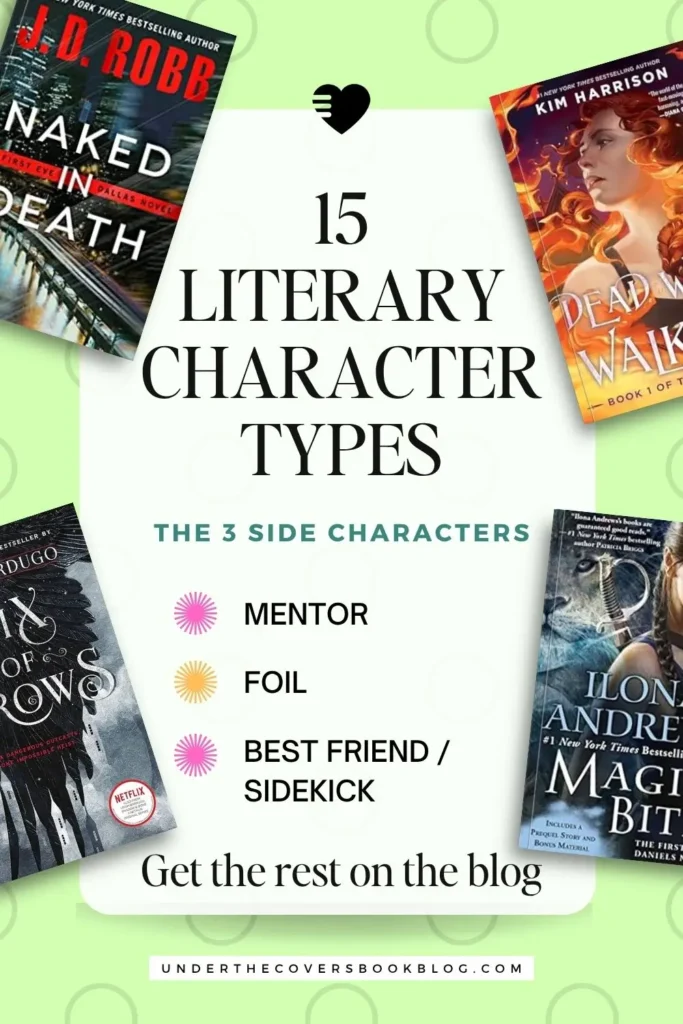
The Mentor
The mentor’s job is to train or guide our protagonist. This is often someone with more experience, knowledge or power. They of course show up more in some genres than others. For example, in fantasy and romantasy they can feel like a fixture and tend to be someone we attach to.
Which makes it all the more devastating when the story takes them away. The mentor’s death or disappearance is one of fiction’s oldest structural moves, and it works every time because the mentor is not just a teacher. They are the protagonist’s proof that growth is possible. Losing them forces the protagonist to carry that forward alone.
If you have ever felt wrecked by a side character’s exit from a series, there is a good chance a mentor was involved.
The Best Friend and Sidekick
One of my favorite literary character types! The best friend or sidekick is a character that shows up for the bad decisions, the moments when our protagonist can’t hold it together. They are not just there for comic relief or sounding board. In the best books, they are fully realized characters that have their own wants and losses and just happen to be standing next to our main character.
When I think of some of my favorites, the list can be long, but the first two that came to mind were Officer Peabody in the In Death series by J.D. Robb and Jenks in the Hollows series by Kim Harrison.
The difference between a best friend and a sidekick is usually one of agency. A sidekick usually follows but a best friend pushes back. And sometimes they can be both. When a supporting character gets their own spinoff, it is almost always because they were a best friend, not a sidekick.
Foil
A foil is a character whose traits contrast with another character’s in a way that makes both of them sharper. A reckless character paired with a cautious one. An idealist next to a cynic. A character who chose love next to one who chose power.
Foils don’t have to be enemies, and they do not have to be obvious. Sometimes the most effective ones are the characters who seem similar on the surface but they may be opposite in one important thing. Once you notice foils, you see how much meaning lives in that contrast between characters rather than in any one character alone. It can change how you read big ensemble casts entirely.
Would you like to save this?
The Narrator’s Lens
The narrator is not just a delivery mechanism. They are a choice, and that choice shapes everything you think you know about a story.
Narrator
The narrator is the one telling the story. Sometimes it can be a character living inside the book, but others it can be more distant almost like someone looking back. This gets into points of view (which we will cover in another post). Either way, the narrator controls everything: what you see, what you miss, the tone of the story and how much you are allowed to trust.
We often focus so much on plot that they don’t ask who is telling the story. But the narrator is the first and most important decision in any book.
Unreliable Narrator
On the flip side of that we also have an unreliable narrator. This is a narrator whose version of events cannot be fully trusted. They may be lying outright, or they may be telling the truth as they understand it, which is sometimes worse. Trauma, obsession, immaturity, self-deception can all make a narrator unreliable in different ways, and each produces a different reading experience.
This is one of the most useful terms you can understand as a reader because it completely changes how you perceive the story. With a reliable narrator, reading is absorbing everything as truth. With an unreliable one, reading is detective work. And I love it!
You find it in thriller and domestic suspense a lot. Gone Girl by Gillian Flynn is the textbook case, two narrators both shaping the truth to fit what they need you to believe. You also find it romance, if less common, like in The Poisoner by I.V. Ophelia where the heroine’s perspective is shaped by fear and obsession and certainly plays with a gothic unreliable narrator energy.
Hero Archetypes and Character Arc
Not all heroes are heroic. Not all characters change. These are terms that can help you while talking about a character and what they are doing for the story and why they hit they way they do. And let’s face it, these are some of the literary character types that shape the story the most.
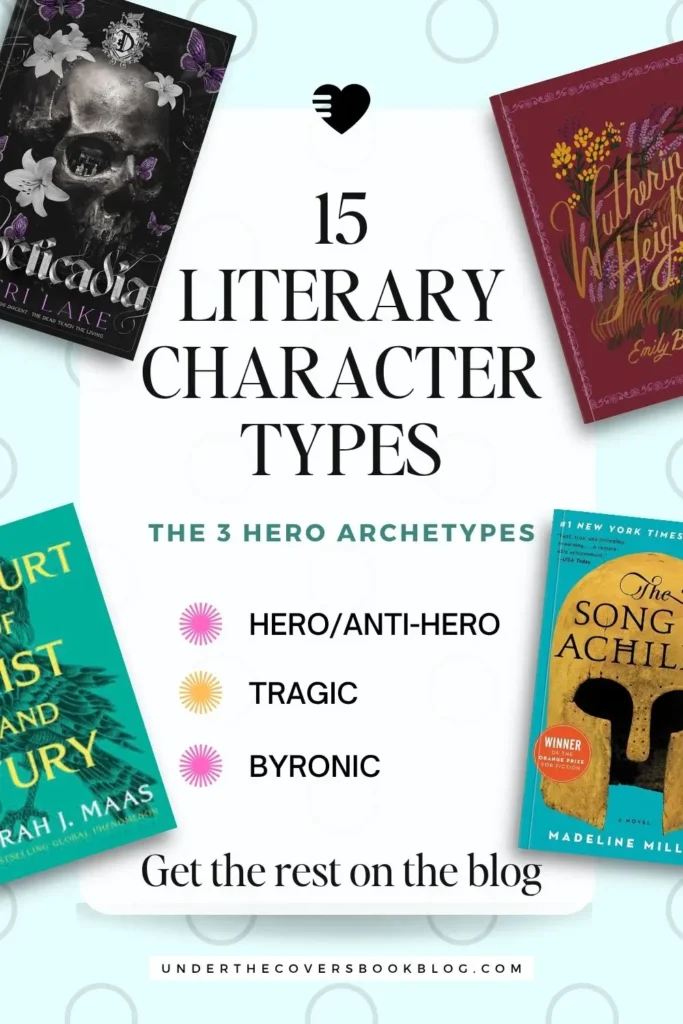
Hero and Antihero
The hero is a character who embodies qualities we traditionally associate with courage, moral strength, or self-sacrifice. In literary terms, the hero is the figure readers are meant to admire. Not necessarily perfect, but oriented toward something good, even at personal cost.
The antihero is what happens when we break that mold. An antihero is a main character who lacks the conventional heroic qualities. They may be selfish, cynical, morally compromised, or emotionally closed off in ways that make them genuinely difficult to root for. And yet we do. We root for them anyway, which is the whole trick of the antihero: they make us examine why we are invested, which is a more interesting question than whether we admire them.
Antiheroes are everywhere, especially in modern dark romance and romantasy. Kaz Brekker in Six of Crows does not have a redemption arc so much as a grudging acknowledgment that he is capable of caring about someone. Rhysand in ACOMAF is introduced as a villain and reconstructed as something more complicated. The antihero works because moral ambiguity, in fiction as in life, is more honest than easy heroism.
Tragic Hero
The tragic hero is a character (often admirable, often powerful) whose downfall comes from a fatal flaw, a terrible choice, or forces they cannot escape. Their story ends in ruin, loss, or profound suffering, and the tragedy is not random. It is earned, which is what makes it devastating rather than merely sad.
The key distinction is that a tragic hero is not just someone bad things happen to. The downfall has to connect to who they are. Hubris, obsession, loyalty pushed past reason, love that becomes destruction… these are the engines of tragic arcs, and once you recognize them, you see how many beloved characters in fantasy and romance are walking toward an ending the reader can feel coming long before the character does.
Achilles. Heathcliff. Any character in a Sarah J. Maas series who gets too much early page time. You know the feeling.
Byronic Hero
The Byronic hero is dark, brooding, intelligent, emotionally tormented, and almost always magnetic in a way that is difficult to fully justify. He is rebellious, often isolated, morally ambiguous, and carrying something (a past, a secret, a wound) that he will not explain directly but it colors every interaction.
Named for the poet Lord Byron and the characters he wrote, this type has never gone out of fashion because readers have never stopped being drawn to the specific alchemy of difficult and compelling. If you have ever found yourself defending a love interest who objectively behaves badly, chances are you have met a Byronic hero and lost the argument with yourself.
Mr. Rochester in Jane Eyre. Heathcliff in Wuthering Heights. Rhysand, pre-reveal. In romance, the Byronic hero is practically a founding archetype. The brooding Highland lairds of historical romance who are rude to everyone except, eventually, her. The dark romance anti-heroes who do genuinely terrible things and somehow still have a fan Discord server. Or my beloved Devryck from Nocticadia by Keri Lake, who is modern Byronic with a scalpel, a tragic backstory, and a campus full of red flags.
The Byronic hero endures because the fantasy is not really about bad behavior, it is about being the person who finally gets through to them.
Dynamic and Static Characters
A dynamic character changes over the course of a story in some meaningful way. That change can be emotional, moral, psychological, or relational. But it has to be real, not just circumstantial. A character who ends the book richer or married is not necessarily dynamic. A character who ends it seeing themselves or the world differently is.
A static character does not undergo that internal shift. They remain fundamentally the same from beginning to end.
Static does not mean badly written. Some static characters are powerful precisely because they do not change. Their consistency throws the dynamic characters’ transformation into sharp relief, or acts as a stabilizing force in a chaotic story. A beloved mentor who holds the same values from page one to the last page can be more emotionally resonant than a character who changes twice per book.
The useful question is not “did this character change” but “what does the author want their consistency or change to mean?” That question will tell you more about a book’s thematic intentions than almost any other.
Final Thoughts
When you finish a book wrecked by a character’s ending, or find yourself defending someone you know you probably should not, or notice that the narrator has been quietly lying to you for two hundred pages, these terms are just the vocabulary for what you already felt and you can now express it. They make the conversation better, not the reading more clinical.
If you want to keep pulling on these threads, the literary character types that show up most often in gothic romance tend to cluster around Byronic heroes, tragic arcs, and narrators you cannot quite trust. And if the best friend character in a romance keeps stealing scenes from the protagonist, there is a decent chance you are about to discover your new favorite friends to lovers read.
The characters that stay with us are never accidental. Now you have better words for why.


